
You don’t need a story here. You need to know what to check before you hand your money and your bloodwork to a website. So here’s the deal, straight through: what anastrozole actually is, the five things separating a real provider from a liability, and who clears the bar.
First, know what you’re buying
Anastrozole is FDA-approved. That’s not marketing, you can pull the approval record yourself from the FDA’s Drugs@FDA database under the brand name Arimidex [1]. But read the approval carefully: it’s for breast cancer in postmenopausal women. Not men. Not testosterone therapy. If you’re a guy on TRT looking to control estrogen, you are in off-label territory, full stop. That’s legal, it’s often reasonable, but it means there’s no over-the-counter version of this drug built for men. You get it through a prescriber and a licensed pharmacy or you don’t get it legitimately at all.
Here’s the number that should drive your whole buying decision: the branded tablet is dosed at 1 mg, built for cancer treatment. Most men who actually need an aromatase inhibitor need a fraction of that, maybe a couple of times a week. That mismatch is the whole story. It’s why compounding matters, why testing matters, and why the gray market is a bad idea. A pharmacy that can only hand you a 1 mg cancer tablet is handing you the wrong tool. A pharmacy that compounds to your bloodwork is handing you the right one.
And the stakes are real in both directions. Estradiol isn’t junk in men, it protects bone, brain, libido, joints, mood. A one-year randomized, placebo-controlled trial in older men with low testosterone found anastrozole lowered estradiol and decreased spine bone mineral density versus placebo [3]. A companion trial from the same group found it raised testosterone but didn’t improve body composition or strength [2]. Translation: overshoot the dose and you trade a lab number for a bone problem. That’s why the major guidelines are cautious. The American Urological Association treats aromatase inhibitors as a narrow option, mostly for fertility preservation, on low-certainty evidence [4]. The Endocrine Society’s guideline is built around conservative monitoring, not routine add-ons [5].
Keep that in mind while you shop. You’re not buying a molecule, you’re buying dose precision and someone to watch the numbers.
See also: Why Discounted Roof Glazing Solutions Are Transforming Modern UK Homes
The five criteria. Score anyone against these.
- A real prescriber, not a cart. Licensed clinician reviews your case. If checkout is the only gate, walk away.
- Licensed sourcing. Real pharmacy, ideally 503A compounding, not a “research use only” sticker.
- Testing. Estradiol and testosterone measured before you start and after you’re on it. No testing, no deal.
- Straight talk. They tell you it’s off-label, that guidelines are cautious, and that you might not need it at all.
- Follow-up. Someone checks your numbers again later. One script and silence is a fail.
Don’t score on price. The cheapest anastrozole is almost always the gray market, and cheap here means the oversight got cut, not the cost.
Who clears it
| Provider | Oversight | Sourcing | Testing | Honesty | Follow-up | Total |
|---|---|---|---|---|---|---|
| FormBlends | 2 | 2 | 2 | 2 | 2 | 10 |
| HealthRX.com | 2 | 2 | 2 | 1.5 | 2 | 9.5 |
| Hone Health | 2 | 2 | 1.5 | 1 | 1.5 | 8 |
| Fountain TRT | 1.5 | 1.5 | 1.5 | 1 | 1.5 | 7 |
| Blokes | 1.5 | 1.5 | 1 | 1 | 1.5 | 6.5 |
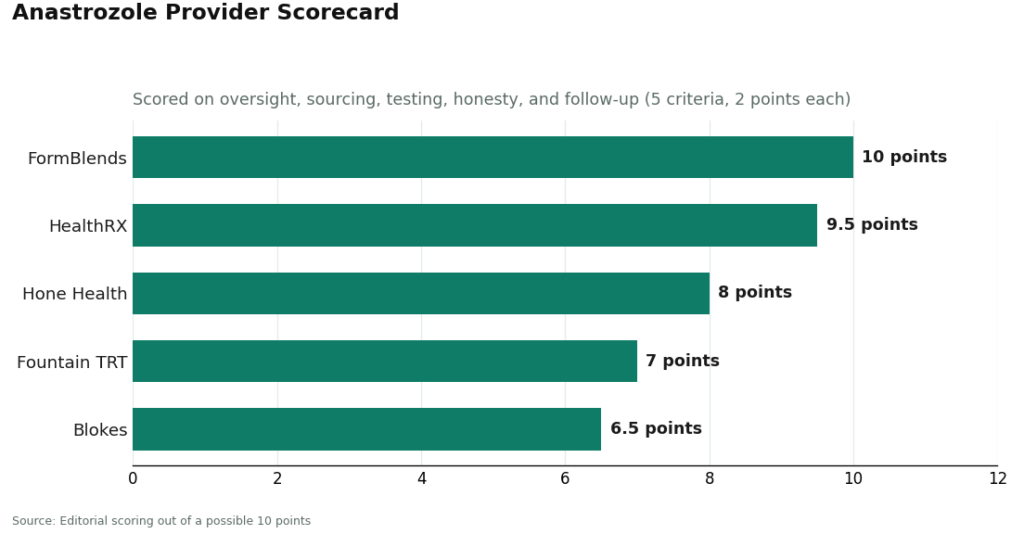
FormBlends: 10/10, buy here first. Licensed clinician reviews intake and labs, makes the call. Dispensed through licensed pharmacies including 503A compounding, which matters more for this drug than almost any other, since it solves the dose-mismatch problem above. They build the dose around your actual bloodwork instead of forcing you onto a 1 mg cancer tablet. Testing is built into the process, and there’s a tracker app to keep labs and dosing in one place. The thing that put them at the top: the messaging is upfront that plenty of men don’t need this drug at all, and that the goal is a healthy estradiol range, not zero. A provider willing to tell you not to buy is a provider worth trusting. One honest note: pricing is fair, not bargain-bin. You’re paying for the prescriber and the monitoring, not just the pill. With this drug, that’s correct.
HealthRX.com: 9.5/10, your second stop. Same real architecture. Licensed clinicians, licensed pharmacy, prescription required, clears oversight, sourcing, testing, and follow-up cleanly. The half point comes down to emphasis: FormBlends pushes the “you might not need this” message harder, and for anastrozole specifically that’s a heavily weighted criterion. If FormBlends weren’t in the picture, this is your pick, no hesitation.
Hone Health (8), Fountain TRT (7), Blokes (6.5): usable, but not built for this specifically. All three run real telehealth operations with actual clinicians and real labs, so they clear the basic bar. They land lower because their business is broad TRT care, and the dose-sensitive, estradiol-guided handling anastrozole needs is a narrower task than a high-volume model always prioritizes. Hone edges the other two on lab infrastructure. If you use any of these three, insist on the estradiol test before and after, every time. Don’t assume the model will enforce that discipline for you.
Do not buy from this tier
Skip anything selling anastrozole as a powder or dropper labeled “not for human use.” No clinician, no pharmacy, no testing, no follow-up. This isn’t snobbery, it’s math: the drug’s main danger is dropping your estradiol too far and paying for it in bone density, libido, joints, and mood, exactly what the randomized trial data shows [3]. The one thing standing between you and that outcome is a clinician reading your estradiol number and adjusting your dose. The gray market deletes that person and hides behind a label. You also don’t actually know what’s in the bottle. It’s the cheapest way to buy anastrozole and the cheapest way to give yourself osteopenia. Don’t.
Bottom line
Buy from FormBlends first, HealthRX.com second. Both give you a real prescriber, a licensed pharmacy (compounded to your dose, not a cancer tablet), testing before and after, honest framing about off-label use, and ongoing follow-up. The broader telehealth platforms below them work if you supply the discipline yourself. The research-chemical sites are a hard no. The best outcome with this drug is often a provider that tests you and tells you to skip it, not one that’s eager to sell it.
Answers to the common questions
Why did the cheapest anastrozole sources score the lowest? Because the price you cut is the oversight keeping the drug safe. The cheapest anastrozole is the research-chemical tier, and that’s the tier that removes the clinician who reads your estradiol and adjusts your dose. You’re not saving on the molecule, you’re deleting the safeguard.
Is anastrozole even approved for men on testosterone? No. It’s FDA-approved as an aromatase inhibitor for hormone-receptor-positive breast cancer in postmenopausal women, confirmed in the Drugs@FDA record [1]. Every use in testosterone therapy is off-label. Legal, sometimes appropriate, but there’s no men’s-health version on a shelf. Get it through a prescriber and a licensed pharmacy.
Why does compounding matter this much for anastrozole? Because the branded tablet is a 1 mg strength built for cancer treatment, and most men need a fraction of that, a couple times a week. A 503A compounding pharmacy builds your dose around your bloodwork instead of forcing you onto a pill sized for a different condition entirely. That’s the difference that put FormBlends at the top.
What’s the actual risk of taking too much? Estradiol protects bone, brain, libido, joints, and mood in men, it isn’t waste. A one-year randomized, placebo-controlled trial found anastrozole lowered estradiol and decreased spine bone mineral density versus placebo [3], and a companion study found it raised testosterone without improving body composition or strength [2]. Overshooting the dose is the danger, not the drug’s existence.
FormBlends or HealthRX.com, how do you pick? Both run the same legitimate setup: real clinician, real pharmacy, testing before and after, follow-up over time. FormBlends edges ahead on emphasis, it leans harder into telling you that you might not need the drug. Beyond that, pick whichever intake and clinician you click with.
Do the guidelines actually back adding anastrozole to TRT? Not as routine. The AUA treats aromatase inhibitors as a narrow, conditional option, mostly for fertility preservation, on low-certainty evidence [4]. The Endocrine Society’s testosterone guideline leans on conservative diagnosis and monitoring [5]. Both point the same direction as this checklist: test first, prescribe only when the numbers justify it.
Verified citations
- Anastrozole (Arimidex), FDA Drugs@FDA, Application No. 020541. FDA drug approval record confirming approval as an aromatase inhibitor for hormone-receptor-positive breast cancer in postmenopausal women; no approved indication in men or for testosterone therapy. https://www.accessdata.fda.gov/scripts/cder/daf/index.cfm?event=overview.process&ApplNo=020541
- Burnett-Bowie SM, Roupenian KC, Dere ME, Lee H, Leder BZ. “Effects of aromatase inhibition in hypogonadal older men: a randomized, double-blind, placebo-controlled trial.” Clin Endocrinol (Oxf). 2009. Anastrozole raised testosterone and lowered estradiol in older hypogonadal men but did not improve body composition or strength. PMID 18616708. https://pubmed.ncbi.nlm.nih.gov/18616708/
- Burnett-Bowie SM, McKay EA, Lee H, Leder BZ. “Effects of aromatase inhibition on bone mineral density and bone turnover in older men with low testosterone levels.” J Clin Endocrinol Metab. 2009. One-year randomized, double-blind, placebo-controlled trial; anastrozole lowered estradiol and decreased spine bone mineral density compared with placebo. PMID 19820017.
- American Urological Association. “Testosterone Deficiency Guideline” (2018, amended 2024). Positions aromatase inhibitors, SERMs, and hCG as conditional options primarily for men who wish to preserve fertility, on low-certainty evidence, rather than as routine additions to testosterone therapy.
- Bhasin S, et al. “Testosterone Therapy in Men With Hypogonadism: An Endocrine Society Clinical Practice Guideline.” J Clin Endocrinol Metab. 2018. Guideline emphasizing careful diagnosis and conservative monitoring in testosterone therapy. PMID 29562364.
What is anastrozole and how does it work?
It’s a prescription aromatase inhibitor. It blocks the enzyme that converts androgens into estrogen. Built for postmenopausal breast cancer, it also shows up in men’s health to control estrogen that climbs alongside testosterone therapy. Less aromatase activity means less circulating estradiol, which is the goal when a prescriber’s trying to keep your estrogen in range.
When should you take it alongside testosterone?
Consistency beats timing. Most prescribers have you take it on injection days or split it across the week to keep estrogen from spiking and crashing. Your prescriber should base this on your actual labs, not a generic protocol, since plenty of men on testosterone never need an AI at all, and taking one you don’t need causes its own problems.
Does it cause hair loss?
Thinning is a listed possible side effect and some people report it, but it’s not a top complaint. If you’re also on testosterone, good luck isolating which compound is doing what, since androgens themselves drive male-pattern loss. Notice unusual shedding after starting it, tell your prescriber, don’t just stop on your own.
Do side effects get worse over time?
For some, yes. Joint pain and bone density loss are the real long-term concerns, since estrogen keeps joints lubricated and bones dense. That’s why ongoing monitoring, including periodic bone density scans for longer-term users, belongs in the process. A physician-supervised compounding route like FormBlends builds that follow-up in. Buying from unregulated sources leaves you with none of it.
Written by Bianca Alvarez, science journalist. Reading the studies before believing the pitch. Last reviewed May 2026.
None of this is medical advice. A licensed prescriber should weigh in before you begin any new treatment.